
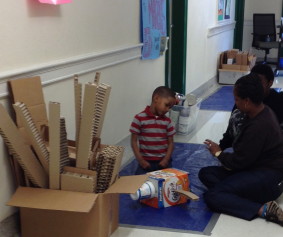
Somewhere early on really young kids turn a corner on excitement for STEM, science, technology, engineering and math, activities. Most young kids begin school excited about anything and everything involving STEM. And yet…far too soon kids are divided, kids begin to fail or to see themselves as failures. STEM becomes a club they just don’t belong in and are not smart enough for or don’t have high enough grades for. And this happens for many kids before they even leave elementary school!
UC Berkeley professor Martin Covington defines the Fear of failing –
If a person doesn’t believe he or she has the ability to succeed—or if repeated failures diminish that belief—then that person will begin, consciously or not, to engage in practices or make excuses in order to preserve his or her self-worth both in his or her own eyes and in the eyes of others.
http://greatergood.berkeley.edu/article/item/how_to_help_kids_overcome_fear_of_failure
When we consider world-famous inventor Thomas Edison we might name him a grandfather of STEM education. Edison said some things that impact our thinking today regarding tinkering, experimenting, data collection and failure.
“I have not failed. I’ve just found 10,000 ways that won’t work.” ― Thomas A. Edison
When you have exhausted all possibilities, remember this – you haven’t.” ― Thomas A. Edison
“Our greatest weakness lies in giving up. The most certain way to succeed is always to try just one more time.”
― Thomas A. Edison
As I have observed our youngest students, my own and so many others for 29 years in public education, I believe there are three ways we can help our elementary students avoid fear of failure in STEM education:
1. Students participate, hang in there! Adults, find paths for accessible participation through collaborative cooperative hands-on learning environments! Try, persevere, once you’re in, you’ll be able to get an idea of the pieces and parts you enjoy and you’re great at. And they are there!
2. Help students learn mindfulness and self-compassion in their own work as they succeed and as they fail. Young people, and all people with these skills, recover more quickly. They adapt to the ebb and flow of trial and error and the notion or experimenting.
3. Build positive relationships. Caring is motivational. Attachment leads to motivation.
Let’s keep kids grounded in trying and tinkering instead of searching for the correct answer. Let’s help kids follow Edison’s lead to 10,000 experiments.